
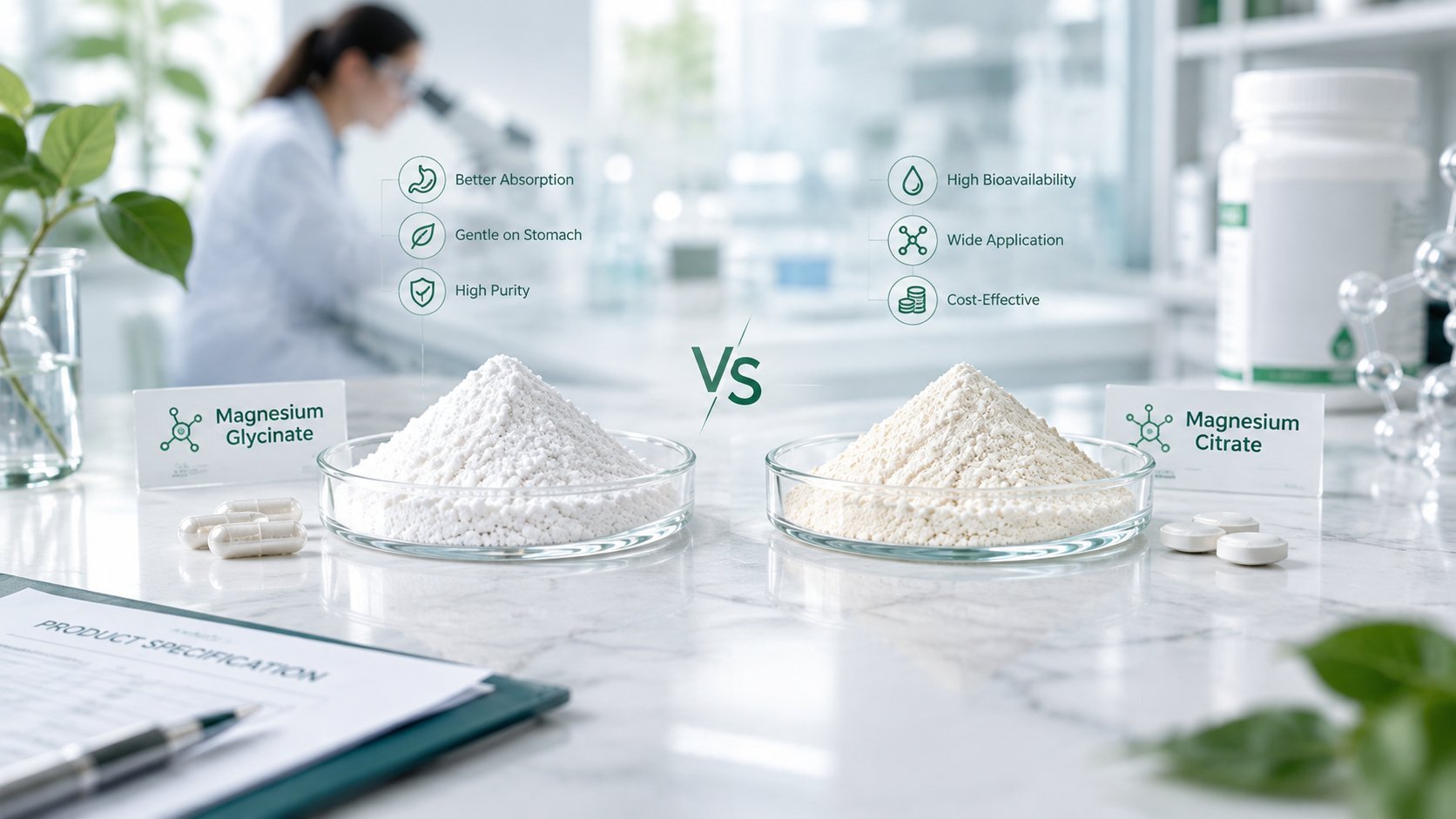

Magnesium Glycinate vs. Magnesium Citrate:
Magnesium is widely used in dietary supplements, functional nutrition products, sports nutrition formulas and wellness products.
However, magnesium is not a single ingredient.
Different magnesium compounds can differ in chemical form, elemental magnesium content, formulation characteristics, processing requirements and suitability for different finished-product formats.
Among the commonly considered forms, magnesium glycinate and magnesium citrate are frequently evaluated by supplement brands and formulators.
For manufacturers and procurement teams, the question is not simply which ingredient is “better.”
The more useful question is:
Which magnesium ingredient is more appropriate for the intended formulation, dosage form, target market and manufacturing process?
This guide explains the key differences between magnesium glycinate and magnesium citrate from a formulation and sourcing perspective.
1. What Is Magnesium Glycinate?
Magnesium glycinate is a magnesium compound associated with glycine.
It is commonly considered by supplement manufacturers looking for a magnesium ingredient suitable for capsules, tablets, powders and other nutritional supplement formats.
From a formulation perspective, buyers may evaluate magnesium glycinate based on:
- Chemical form
- Elemental magnesium content
- Powder characteristics
- Solubility or dispersibility requirements
- Dosage form
- Stability
- Taste considerations
- Manufacturing process
- Supplier documentation
For commercial production, the actual specification of the material should always be confirmed through the supplier’s current technical documentation.
2. What Is Magnesium Citrate?
Magnesium citrate is a magnesium salt associated with citric acid.
It is another commonly used magnesium ingredient for dietary supplement formulations.
Depending on the specific grade and manufacturing specification, magnesium citrate may be supplied in different physical forms and specifications.
When evaluating magnesium citrate, formulators commonly consider:
- Elemental magnesium content
- Grade
- Particle characteristics
- Solubility
- Processing behavior
- Taste
- Finished-product format
- Applicable regulatory requirements
- Supplier documentation
The specific characteristics can vary between grades and suppliers, so product specifications should be reviewed before formulation decisions are made.
3. Magnesium Glycinate vs. Magnesium Citrate
The two ingredients should not be evaluated solely by ingredient name.
A professional comparison should include several dimensions.
| Factor | Magnesium Glycinate | Magnesium Citrate |
| Chemical form | Magnesium associated with glycine | Magnesium associated with citric acid |
| Formulation use | Commonly considered for capsules, tablets and powders | Commonly used in supplement formulations |
| Taste considerations | Formulation-dependent | Formulation-dependent |
| Powder characteristics | Grade-dependent | Grade-dependent |
| Elemental magnesium | Must be confirmed by specification | Must be confirmed by specification |
| Solubility/dispersibility | Grade-dependent | Grade-dependent |
| Manufacturing suitability | Depends on formula and process | Depends on formula and process |
| Documentation | COA/TDS/SDS should be requested | COA/TDS/SDS should be requested |
The table illustrates an important point:
The ingredient name alone does not provide enough information for a purchasing decision.
4. Elemental Magnesium Matters
One of the most important considerations when comparing magnesium ingredients is elemental magnesium content.
A magnesium compound contains magnesium as part of a larger chemical structure.
Therefore, the amount of the compound used in a formula is not necessarily equal to the amount of elemental magnesium delivered by that ingredient.
For supplement manufacturers, this distinction is important when calculating:
- Formula composition
- Serving size
- Magnesium contribution
- Raw-material dosage
- Cost per serving
- Finished-product specifications
When evaluating a supplier, request the current specification and COA rather than relying only on a product name or online description.
5. Formulation Considerations
The choice between magnesium glycinate and magnesium citrate should be made according to the finished product.
Capsules
Capsule formulations may require consideration of:
- Bulk density
- Powder flow
- Dosage weight
- Particle size
- Capsule size
- Excipient requirements
Tablets
For tablet formulations, manufacturers may evaluate:
- Compressibility
- Flowability
- Moisture
- Particle size
- Binding requirements
- Manufacturing process compatibility
Powder Products
Powder products can introduce additional considerations such as:
- Dispersion
- Solubility
- Taste
- Flavor compatibility
- Mixing uniformity
- Packaging stability
There is therefore no single magnesium ingredient that is automatically suitable for every product.
6. How Should Supplement Brands Compare the Two Ingredients?
A practical evaluation can follow six steps.
Step 1 — Define the finished product
First determine whether the final product will be:
- Capsule
- Tablet
- Powder
- Sachet
- Functional beverage
- Other dosage form
Step 2 — Define the required magnesium specification
Determine the target elemental magnesium level and other relevant specifications.
Step 3 — Evaluate processing characteristics
Ask the supplier for information related to:
- Particle size
- Solubility
- Bulk density
- Moisture
- Flowability
- Other applicable technical characteristics
Step 4 — Review documentation
Request:
- COA
- TDS
- SDS
- Specification sheet
- Relevant certificates
Step 5 — Test samples
A laboratory or pilot production test can help evaluate the actual material in the intended formula.
Step 6 — Evaluate supply capability
For commercial purchasing, also confirm:
- Packaging
- MOQ
- Lead time
- Batch consistency
- Export documentation
- Customization requirements
- Communication and technical support
7. Why Supplier Quality Matters
Two suppliers may offer materials under the same ingredient name while having different specifications, production processes and quality-control systems.
For this reason, professional buyers should not compare suppliers only by price per kilogram.
A broader supplier evaluation should include:
Product → Quality → Documentation → Supply → Communication
This approach helps procurement teams evaluate whether a supplier can support not only the initial sample but also future commercial production.
8. What Documents Should You Request?
Before purchasing magnesium ingredients in bulk, buyers should normally request applicable documentation such as:
COA
Certificate of Analysis.
It provides batch-specific analytical information according to the supplier’s quality system and product specification.
TDS
Technical Data Sheet.
It provides technical information about the ingredient.
SDS
Safety Data Sheet.
It provides relevant safety, handling, storage and transportation information.
Specification
The product specification defines the agreed technical requirements of the material.
Depending on the market and application, additional documentation may also be required.
9. How to Choose Between Magnesium Glycinate and Magnesium Citrate
Instead of asking:
“Which magnesium ingredient is better?”
A formulator can ask:
- What finished product am I developing?
- What elemental magnesium level do I need?
- What physical characteristics does my production process require?
- Does the ingredient work with my other raw materials?
- What documentation is required for my market?
- Can the supplier provide consistent commercial batches?
- Can the supplier support future scale-up?
This creates a more practical decision-making framework.
10. Buyer Checklist
Before selecting a magnesium ingredient supplier, confirm:
Product
- Ingredient name
- Chemical form
- Grade
- Appearance
- Elemental magnesium specification
- Particle characteristics
Quality
- Current COA
- Specification
- TDS
- SDS
- Relevant quality certificates
Supply
- Sample availability
- MOQ
- Packaging
- Lead time
- Batch consistency
Commercial
- Price
- Payment terms
- Export documentation
- Technical support
- Communication
11. Conclusion
Magnesium glycinate and magnesium citrate can both be considered in dietary supplement formulation, but the appropriate choice depends on the specific product and manufacturing requirements.
For supplement brands and ingredient buyers, the selection process should consider more than the ingredient name.
Chemical form, elemental magnesium content, formulation characteristics, documentation, quality control and supply capability should all be evaluated together.
For commercial sourcing, working with a supplier that can provide clear specifications, batch documentation and sample evaluation support can make the qualification process more efficient.
FAQ
Is magnesium glycinate the same as magnesium citrate?
No. They are different magnesium compounds with different chemical forms and formulation characteristics.
Which magnesium ingredient should supplement manufacturers choose?
The appropriate ingredient depends on the intended formulation, dosage form, specifications, manufacturing process and target market.
What documents should I request from a magnesium ingredient supplier?
Common documents include COA, TDS, SDS and the current product specification. Additional documentation may be required depending on the market and application.
Can magnesium ingredients be purchased in bulk from China?
Yes, international buyers can source nutritional ingredients from Chinese manufacturers and suppliers, but supplier qualification, documentation and sample testing should be part of the procurement process.
Should I request a sample before placing a bulk order?
For new suppliers or new ingredients, sample evaluation is a practical step before commercial-scale purchasing.