
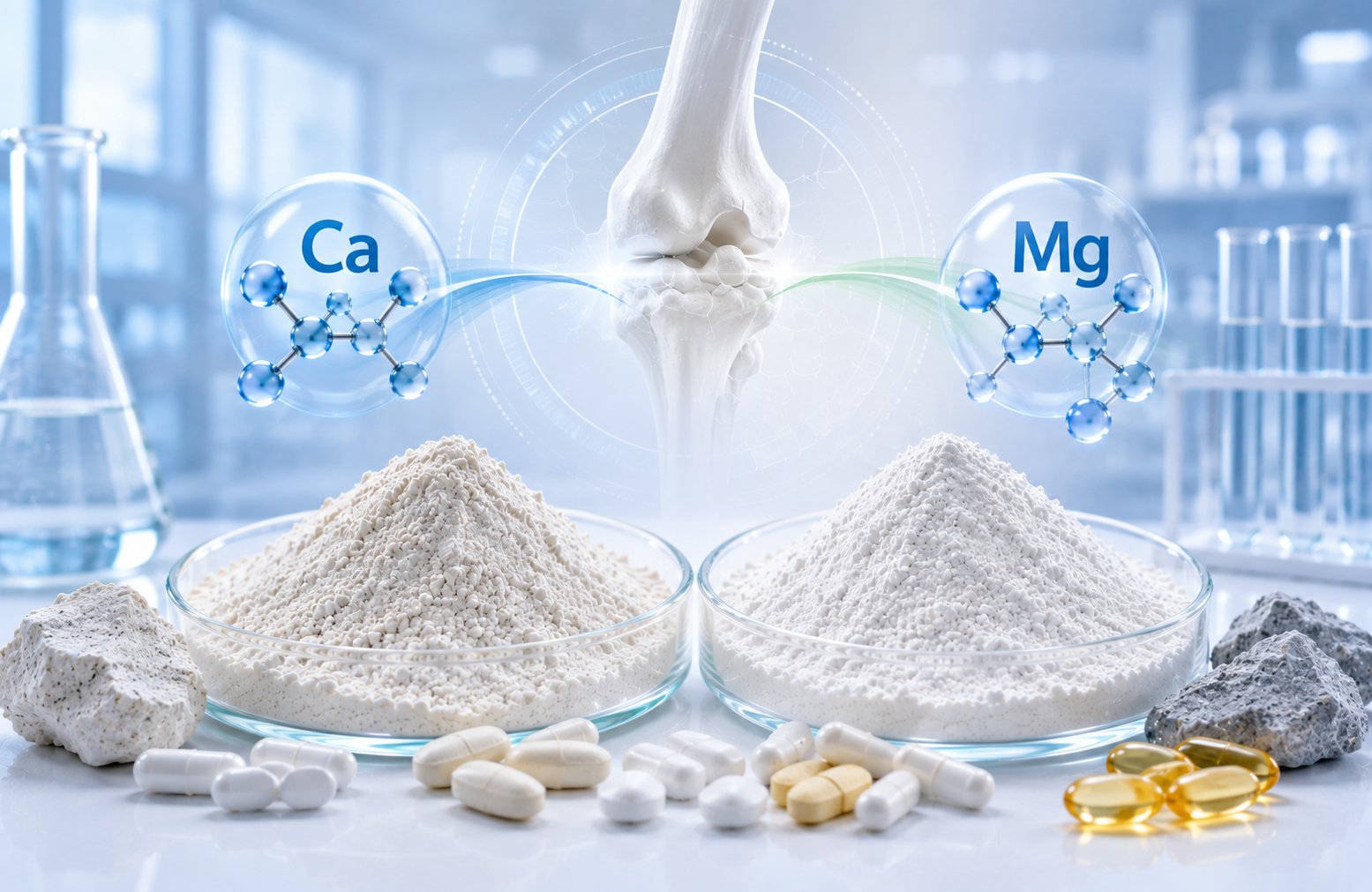

Calcium and Magnesium Ingredients for Dietary Supplements: How Formulators Select the Right Mineral
Calcium and magnesium are two of the most widely recognized minerals in nutritional science.
Both play important roles in human physiology, but they are not interchangeable.
For supplement manufacturers, choosing a calcium or magnesium ingredient requires consideration of the mineral itself, the chemical form, dosage form, formulation, target consumer, cost, and regulatory environment.
Calcium: More Than a Bone Mineral
Calcium is the most abundant mineral in the human body.
According to the NIH, calcium contributes to:
- Bone and teeth structure
- Muscle function
- Nerve transmission
- Blood clotting
- Vascular function
- Hormonal secretion
This broad physiological role explains why calcium is used in many different nutritional products.
Magnesium: A Multifunctional Mineral
Magnesium participates in hundreds of biochemical reactions.
The NIH describes magnesium as a cofactor in more than 300 enzyme systems and notes its role in protein synthesis, muscle and nerve function, energy production, and other physiological processes.
As a result, magnesium ingredients are used across:
- Daily mineral supplements
- Sports nutrition
- Multivitamins
- Functional nutrition
- Specialty mineral products
Why Ingredient Form Matters
Two products may both provide calcium, but the actual ingredients may behave differently during formulation.
Likewise, different magnesium forms may have different physical and nutritional characteristics.
For example, magnesium supplements can be available in forms such as:
- Magnesium oxide
- Magnesium citrate
- Magnesium chloride
- Magnesium glycinate
- Other specialty forms
The NIH notes that magnesium absorption varies among different forms.
Therefore, ingredient selection should be based on the complete formulation rather than a single marketing claim.
A Practical Formulation Framework
When evaluating an ingredient, consider six questions.
1. What is the target mineral?
Calcium?
Magnesium?
Or a combination?
2. What is the finished dosage form?
- Tablet
- Capsule
- Powder
- Sachet
- Beverage
- Functional food
3. What mineral level is required?
The required serving size should be considered together with the ingredient’s mineral concentration.
4. What are the physical requirements?
Consider:
- Powder characteristics
- Solubility
- Flowability
- Stability
- Processing
5. What does the target market require?
The regulatory requirements of the U.S., EU, UK and other markets can differ.
6. What documentation is needed?
At minimum, the buyer should establish what technical and quality documentation is necessary for supplier qualification.
Calcium vs. Magnesium: A Simple Comparison
| Category | Calcium | Magnesium |
| Main mineral role | Structural and physiological | Enzymatic and physiological |
| Major nutritional association | Bones and teeth | Muscle, nerve and energy metabolism |
| Common supplement use | Calcium supplements / multivitamins | Magnesium supplements / multivitamins |
| Example specialty forms | Calcium Glycinate / Calcium Aspartate | Magnesium Glycinate |
| Formulation | Depends on ingredient | Depends on ingredient |
| Supplier evaluation | Specification + COA + quality | Specification + COA + quality |
Building a Mineral Supplement Product
A typical product-development process is:
Market Research
↓
Ingredient Selection
↓
Supplier Qualification
↓
Sample Testing
↓
Formulation Development
↓
Stability / Quality Evaluation
↓
Pilot Production
↓
Commercial Production
↓
Market Launch
This is why a raw-material supplier can become a valuable partner during product development.
Why Documentation Is Part of Ingredient Quality
For B2B buyers, the ingredient itself is only one part of the sourcing decision.
Documentation is equally important.
A professional procurement package may include:
- Product Specification
- COA
- Quality information
- Packaging information
- Batch identification
- Traceability information
- Relevant certifications
- Export documentation
FDA’s dietary supplement CGMP framework specifically emphasizes quality-control systems and component specifications related to identity, purity, strength, composition and contamination limits.





Hi, this is a comment.
To get started with moderating, editing, and deleting comments, please visit the Comments screen in the dashboard.
Commenter avatars come from Gravatar.